04 May 2011

And Then There Were Three—In Belfast


Last Monday, April 28th, we parted ways with Sarah, Robin, Clovis, The Mill and the Republic of Ireland.  A lot of good-byes, but no permanent ones. 

Of this, I’m sure. 

We were greeted quite warmly by Northern Ireland via sunshine and one glaring sign that Spring is a little further along on this side of the island.    

The trees have leafed out.    

The most longed-for assurance of Spring’s victory over Winter.  And with their doing so, they have intensified the depth of the landscape with new shades of green.
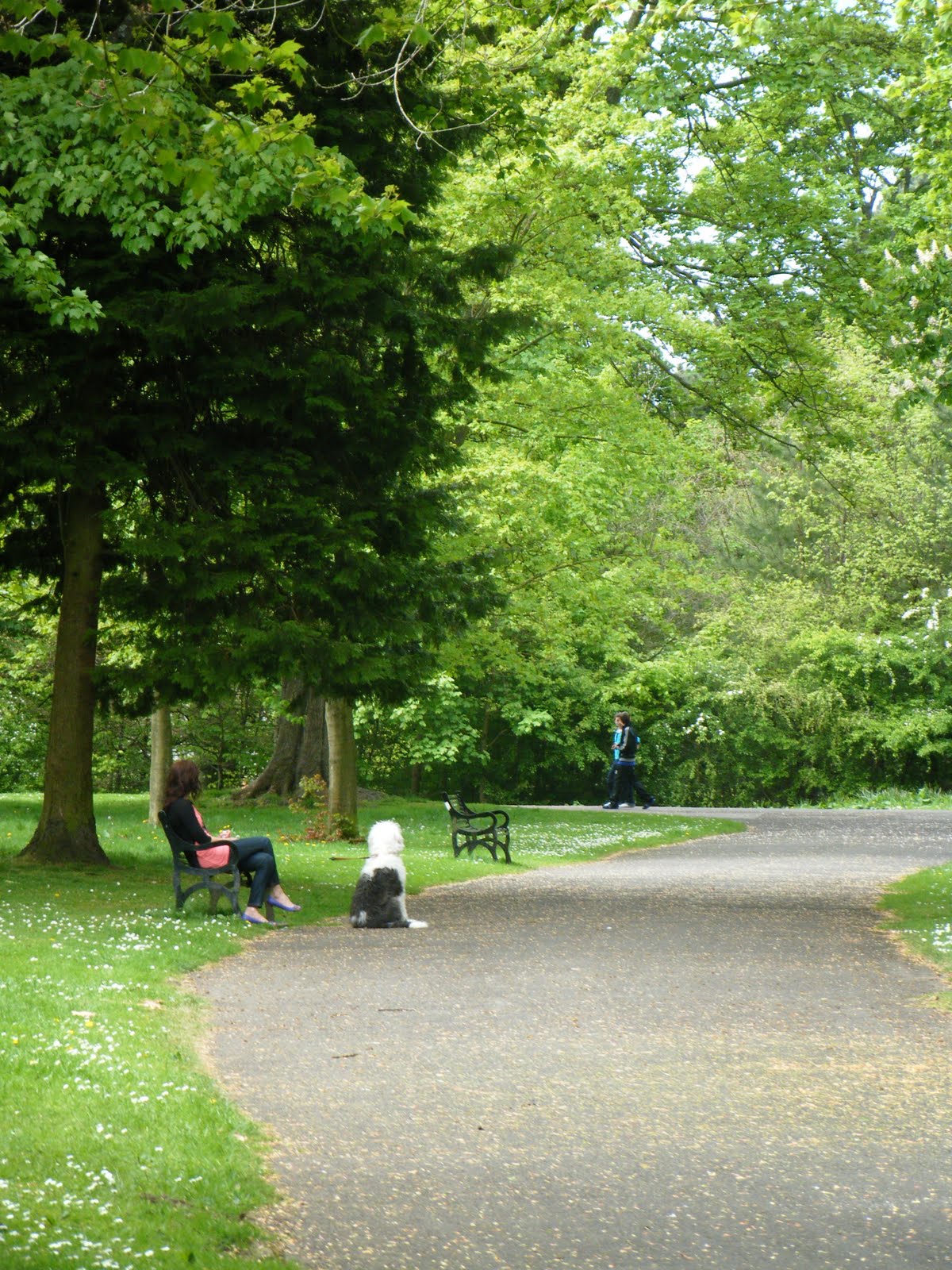

Kathy and I casually acquainted ourselves with Belfast Monday evening by walking down University Street, while simultaneously gawking at the gorgeous architecture of Queen’s University, and through the Botanic Gardens.  It was a brief introduction, but one that revealed Belfast’s beauty and vibrant culture. 

And then there were three. 

On Tuesday morning, we were joined by Nathalie, a Brit and one of Kathy’s dear friends from her year in France.  We had a lovely time together over the next few days. 

Tuesday was a day to more formally acquaint ourselves with the city.  We walked to City Hall

where a Titanic exhibit was on display.  This year marks the 100th anniversary of the ship’s construction, which took place—surprise!—in Belfast. 

As they say here, and very proudly, “Built by the Irish, sunk by the English.” 

We also meandered through Ormeau Park before visiting the Ulster Museum.  After spending an hour and a half dodging rambunctious children, it was time to head to the pub.

But not just any pub—The Crown Bar. 

  
One of the oldest pubs in the city and it has a beautiful interior: tile floor, tin ceiling, oil lamps.  And snugs.  Private booths encased by wood and glass and fitted with a door.  They were designed so that gentlemen could have private conversations, with the added bonus of remaining unseen if wives came looking.  But they are cozy.  And rather elegant for a pub. 


Wednesday we left the city and went on a day trip via tour bus and our driver, Tom, to see the Antrim Coastline. 

That’s Tom, leaning out the bus window.  At this point, he had decided it was entirely appropriate to pull the bus over to the right side of the road, note: the wrong side in this country, and pluck a few flowers from the gorse bush for everyone to smell. 

“The petals smell like coconut,” he said.  No.  They don’t.  He charmed us anyways. 

One of our first stops was the castle in Carrickfergus, which otherwise would have gone unmentioned here had The Queen not bestowed the titles of Baron and Baroness of Carrickfergus upon the Royal Newlyweds.  The town of Carrickfergus hasn’t been more proud since—well, ever.  If I was Princess Catherine, I would be much more excited about the Captain-Hook-like statue that stands outside the castle more than the castle itself or the town of Carrickfergus.


We continued on our way to the Carrick-a-Rede rope bridge.  A swinging, bouncy, thrilling way to cross from the mainland to a tiny island sixty meters away from which fisherman used to net salmon.  Originally, the bridge consisted of just two ropes—one for feet to rest upon and another for hands to hold onto while shimmying across.  Not to worry—the bridge is a little different than it used to be.  There are boards on the bottom and roped sides.  See?


Completely safe.

The waters off the Antrim Coast look tropical—patches of deep blue amongst otherwise calm, aquamarine waters. 


An altogether different character than the battering Atlantic along the Western coast.  But not any more beautiful. 

Our final destination of the day was Giant’s Causeway.  As the legend goes, there were once two feuding giants: one Irish, Finn McCool, and the other Scottish, Benandonner.  Finn yelled across the Irish Sea, challenging Benandonner to fight and then built the Causeway so that he could walk to Scotland to carry out his issued challenge. 

But Finn’s wife, Oonagh, was wiser than her husband. 

She poured a sleeping potion into Finn’s tea and when he didn’t show in Scotland, Benandonner crossed the Causeway to find him.  In the mean time, Oonagh dressed Finn to look like a baby.  When Benandonner asked Oonagh where Finn was, she replied he was out cutting wood but would return shortly and would you like a cup of tea? and please be mindful and not wake the baby.  When Benandonner saw the size of the baby he panicked about the size his father must be and politely declined the cup of tea and hurried back to Scotland, destroying the Causeway as he went to prevent Finn from coming after him. 

There is also a geological explanation for the rock formations of the Causeway involving volcanic activity. 

Yawn yawn yawn. 

This


is all the evidence necessary to convince me the Causeway was built and destroyed by giants.  Columns of hexagonal stones that rise up out of the ocean in varying heights and fit together perfectly like a jig-saw puzzle, creating an awesome landscape that stretches along the coast and into the sea for miles and miles. 

We loved it. 


Thursday was our last day together; Nathalie had a flight to catch in the evening and Kathy and I were heading to Ballylagan Organic Farm, our third and final WWOOF site.  We spent the morning and early afternoon wandering around Belfast looking at various murals of the Troubles, a reminder of Art’s powerful ability to influence and convey, before having a bite of lunch together and parting ways.

At two o’clock Tom, one of our hosts, picked Kathy and me up in the city; we met Patricia when we arrived at the farm half an hour later. 

And so we have found ourselves in the countryside once more, surrounded by rolling pastureland.  But this time in the added company of cows, pigs, horses and chickens. 

More to come about the farm soon. 

In the meantime, just call me Farmer Ellen.   And, although a bit late, Happy May! 

29 April 2011

West of Ireland Snippets

Hello.  I’m afraid the West of Ireland stole my awareness of time—which is not such a good thing for updating blogs.  But what a lovely thing to lose.  I have found that Time’s absence elucidates perspective and purpose—and for this, I have the West of Ireland to thank. 


Anyways.  Hi.

Kathy and I had a delightful stay in Dromore West, County Sligo with Robin and Sarah—and Clovis. 


Sarah is a painter, gardener and cook extraordinaire; Robin is an extremely talented engineer.  Clovis keeps everyone on their toes, which is the most important task after all.  She is a lover.     

We shared two weeks together filled with wonderful meals, laughter, story-telling, laughter, excursions—and more laughter—at their Mill and around Sligo. 

Mill?

Yes.  For over a decade, they have renovated a Georgian-style Mill house from ruins—as in no roof, no floors, no electricity or plumbing—to this:


I’m not impressed either. 

The property on which the Mill sits is absolutely beautiful.  It is tucked in from the roadside and hidden from view by trees and shrubbery.  There are views of the surrounding pastures, the Atlantic Ocean and the mountains nearby—all from the garden.


Sarah’s garden is a tangible manifestation of her artistic eye, her understanding of the interplay between colors and texture, expressed through the medium of plants.  It is unfortunate that Kathy and I won’t be able to see the garden this summer when it is in full bloom, but, as Sarah reminded us, we left our mark. 

Kathy and I spent hours in the garden, digging the beds, turning the soil, removing rocks, stones and, at times, boulders from the deeper, clay-like layers, weeding, transplanting, forming rows and sewing onion bulbs.  And I loved it all. 


I can attribute losing my sense of time mainly to working with my hands in the dirt while listening to the lovely soundtrack of the Mill.  The rush of water flowing over stones in the river.  The bleating sheep in the field across the way.  The mooing cows in the pasture behind.  The melodies of the flitting birds.  And when we weren’t enraptured by our surroundings to the point of silent awe, Kathy and I shared fantastic childhood memories from the years before we knew eachother. Back and forth we went, discussing all sorts of things—from our various involvements in school plays and field trip destinations, to tales of summer camp experiences and horrors, to stories surrounding memorable classmates and teachers, to the items we collected.  And the laughs that ensued?  Immeasurable.  It is such a beautiful thing that there is time to remember those things when working in a garden, shovel in hand, with a dear friend near by.  I just love that.

We also had the opportunity to partake in the quintessential Irish task: stacking turf.  Turf is cut from the bog, dried, in this case delivered via dump truck…


…and stacked.  Jack, I thought of you and how much you would have loved this experience.  Your help would have been greatly appreciated, too.  It took the two of us four hours to stack the entire load—a record, according to Robin and Sarah.  There are times when "Before" and "After" pictures can be most useful. 


Labels aren’t required here. 

And then there were the outings we took together.  Maybe I should say the outing.  Last Thursday we saw TT-3D: Closer to the Edge.  It’s more fun just to chant TT-3D!  TT-3D!  over and over again.  Robin would agree.  It was a documentary about the motorcycle race, The TT, that is held on the Isle of Man off the coast of Scotland every year.  Had I ever heard of this race before?  No.  But it’s not likely that I’ll forget it goes on during the last week in May anytime soon.  Watch this and you’ll understand why.   

We also shared a lovely Easter weekend together.  Sarah and Clovis took Kathy and I to the beach on Saturday morning.  We walked along the shore, ocean on one side


staring lambs from the pasture above on the other.  

  
Then she took us on a lovely drive through the Ox Mountains before dropping us off at The Beach Bar for a couple of hours where we enjoyed a small bite and a Guinness.  After she returned with Robin and Clovis, all of us—except Clovis, that is—sipped a glass of Guinness between nibbles of chips drizzled with vinegar and dipped in ketchup. 

Then we took the most beautiful cliff side walk along Aughris Head.  Clovis, nose down, tail up, lead the way down the grassy path.  A path, dappled with clusters of spicy-sweet scented primrose, that paralleled the outline of the cliffs.   


Up, down, around we went until we settled on a spot near the edge overlooking a cove below and the cliffs of Donegal in the distance. 

And I do mean settled.  Down, down, down we sank into thick, long, lush grass to watch and listen to the undulating waves. 

They’re transfixing, waves.  Rise, crest, tumble, rush, slow, pull, fade.  Over and over and over again.  A series of motions that is timeless.  And fascinating.  And soothing. 

And wonderful. 

Those waves have a way of transporting everyone into their own respective, silent recesses.  A way of settling and easing anxieties.  A way of reminding one that there is so much—time

I needed that reminder very much and was grateful to find it in the company of lovely people and scenery. 

Easter Sunday was another special day.  When Kathy and I walked into the kitchen, we had a wonderful surprise awaiting us: giant, milk chocolate Easter eggs—filled with chocolates.  Of course the Easter Bunny is able to hop across the pond.  I don’t know why I ever doubted him.  Kathy and I celebrated the day with a long run along the Coast Road.  We were hugged by the ocean on one side and rolling green pastures on the other and covered overhead with a blue sky full of fluffy white clouds.  An absolutely perfect day that rolled into a perfect evening. 

We had the pleasure of enjoying Easter dinner with four of Robin and Sarah’s friends, Ann, Kieran, Rachel and Jason.  The menu?  Fantastic.  We began with a pot full of boiled crab claws.  Bits of shell and crab meat went flying into neighbors’ wine glasses—a small expense to pay—with each whack and crack of the hammer, something I’ll be finding excuses to use at the dinner table more often.  We continued on with leg of lamb, deboned expertly before it went on the barbeque by Robin’s engineer-with-a-knife-like skills, potatoes, sautéed leeks and Sarah’s lemon pudding cake, served with heaps of fluffy, vanilla whipped cream.

Lemon pudding cake.  That is worth mentioning twice.  I have a thing about lemon, don’t I, Mom?  I only like it in a few places: drinks, salad dressings and sweets.  On fish?  No, thank you.  In pancakes, bar cookies and icing?  Yes, please.  In pudding cake?  Now that I’ve tasted it—especially in pudding cake. 

Sarah shared the recipe with me and it would be complete sacrilege if I didn’t share it as well.  After all, is there anything worse than a secret recipe?  Not as far as I am concerned.  Enjoy. 

Sarah’s Lemon Pudding Cake

1/4 cup unsalted butter, melted
1 cup sugar, divided
3 large eggs, separated, at room temperature
1/4 cup all-purpose flour
1/4 tsp. plus 1/8 tsp. salt
1 and 1/4 cup milk, at room temperature
1/3 cup lemon juice, at room temperature
Grated zest of one large lemon

Pre-heat oven to 350*
Butter 8 6-oz. ceramic ramekins OR as Sarah does, one large, deep glass baking dish (approximately 10” x 7” x 3”)
In a large bowl, whisk together the butter, 2/3 cup sugar and egg yolks until smooth and fluffy, about one minute
Add flour and salt to the bowl, slowly drizzling in the milk while whisking constantly until the mixture is smooth
Whisk in the lemon juice—the mixture will be thin
Beat the egg whites in a clean bowl with a large balloon whisk until soft and peaks form
Gradually, a few teaspoons at a time, beat in the remaining 1/3 cup sugar
Continue beating until the sugar is completely dissolved and no grittiness remains and medium-stiff peaks form when you pull the whisk away
Scrape the egg whites into the bowl with the egg yolk mixture; sprinkle the zest on top
With the whisk, quickly but gently fold the egg whites into the batter
Divide the mixture evenly among the ramekins OR pour the entire mixture into the glass baking dish; since the cakes do not really rise, you can fill them to within 1/8” of the top
Place the ramekins/glass baking dish in a roasting pan and pour warm water into the pan reaching halfway up the side(s)
Bake for 25 minutes, whether using ramekins or baking dish, until top(s) is/are golden and spring back when touched
Remove the custard(s) from the hot water bath and place on a wire rack to cool
Cool for 30 minutes to set completely as pudding cakes will curdle and separate if stirred while hot
Serve just warm, at room temperature or chilled with mounds of whipped cream flavored with vanilla extract or vanilla bean paste

12 April 2011

An Ever-Changing Landscape

That would probably be the best way to describe this country.  And the dynamic nature of this Irish Jig: ever-changing.  New places, new friendships, new memories.  This past week—Sunday 4 April through Sunday 11 April—has been full of these things.

Sunday.  This was Kathy and my final day on Sherkin Island.  And it turned into quite a memorable one.  We took the ferry to the mainland to spend the afternoon exploring Baltimore.  Exploring might be a bit of an exaggeration given the size of the town, but if Sherkin Island taught us anything, it’s that no matter how small a place may be, there are all kinds of nooks and crannies awaiting—and worth—discovery.  The main attraction of the exploration was the walk to Baltimore’s Beacon. 


It is a fifty foot structure that serves as a marker for the entrance to Baltimore Harbor during the day; the lighthouse takes over this duty at night.  Our first attempt at finding it failed.  But not completely because we formally met the farm animals of Baltimore: mother sheep with their lambs,


a horse,


a ram, 

 
and this fellow:


We were particularly fond of one another.

Kathy and I turned around and headed back towards town to have a bite of lunch before setting out on the correct path.  The sign with the word “BEACON” plastered across it might have had something to do with our success.  Before making the final ascent up to the Beacon, we encountered another helpful sign:


That was not an exaggeration. 

Remember when I said the Beacon is fifty feet tall?


Those cliffs are easily three times that height.  But there is a sense of freedom that comes with the ability to sit out on the edge, without the hindrance of a fence, and have an unobstructed view of the sparkling ocean waters below and beyond.  It was a lovely finale to our experience on Sherkin.         

Monday.  The Island gave way to the mainland.  Kathy and I arrived in Galway via a lift from Jean Paul and a bus ride.  Jean Paul, the chef on the island, was driving two visiting friends of his from, surprise!, France back to Shannon Airport for their return flight.  From there, we took a bus the rest of the way.  Never mind the fact that Ireland and Indiana are the same size.  It took us eight hours to travel the same distance as the journey between Indianapolis and Chicago.  Needless to say, a nap was necessary upon our arrival in Galway.  After a rest and dinner,


we were feeling much better.  We were feeling much better still after popping in, on a whim, to the pub near our hostel for an after-dinner drink.  A whim that re-routed the subsequent events of the evening.  The atmosphere of the pub was unlike any we have encountered so far.  Between the low lighting and the wooden interior, the live traditional music and the soft murmurs of conversation, a sort of hazy warmth was created. 

And then we met Damien and Kel.  An Irish lad and an Aussie.  Two dear friends traveling together.  Sound familiar?  We struck up a conversation.  About our travels.  About where life was taking each of us, where we hoped to go.  About Irish history and Irish culture—and Irish whiskey.  That bit of the discussion encouraged Damien to treat all of us to a round of Green Spot, a renowned whiskey and one that is sipped “in the company of friends,” as he put it.  Slainte.  Say “Slaaaaan-cha.“  The Irish way to say “Cheers,” Gaelic for health.  It was an unforgettable evening. 

Tuesday.  The city.  Kathy and I explored Galway properly, strolling down the River Walk, through the university grounds, under the Spanish Arch, down by the bay and up and down the streets to pop in and out of the shops.


Wednesday.  The city gave way to the Burren and the Cliffs of Moher.  We boarded the tour bus (I know, I know—but it’s the only way to see it all) and took off for the countryside.  The Burren was beautiful despite its starkness.  Gigantic, bare limestone rocks with plants sprouting through the cracks and crags.  A testament to their strength—to root down, and perseverance—to thrive, in spite of the conditions.

  
And then there were the Cliffs.  The Cliffs.  As in, these cliffs would laugh at the ones by the Baltimore Beacon if they could.   They rise up out of the Angry Atlantic, crashing away below, four hundred feet. 


But staring at them from the cement look-outs wasn’t good enough.  We opted for the other option.  Option B.  B as in Bold.  Brave.  Brainless?  Maybe.  But we did it anyways.  What was Option B?
  
The path along the edge.   


Sitting on the fringe of one sliver of the world, enveloped by the sounds of battering waves and cries of swooping birds underneath, surrounded by blue and green. 


Pure Bliss. 

Thursday.  The city gave way to the Connemara, a beautiful mountainous landscape. 


The features of the day included the river from which the Guinness water is sourced,


the ruins of the property used in The Quiet Man, especially exciting to Kathy,


the bridge used in the same film, upon which John Wayne sat


and Kylemore Abbey.


Friday.  The city gave way to the small town.  Kathy and I stowed ourselves away on the Galway University bus (not stowed away in the proper sense—we paid the fare, but the bus is reserved for students) and were dropped off in Castlebar.  Susie Fry, the niece of my neighbors, was our host for the weekend.  But she was so much more than that.  After a walk around her beautiful gardens and the lake nearby, we sat down to a lovely meal together before turning in for the night.    

Saturday.  The small town gave way to the mountain.  And not just any mountain. Croagh Patrick.  The mountain from which St. Patrick drove all the snakes of Ireland into the sea.  And we climbed it.  Susie, Kathy and I.  Did I mention Croagh means mountain in Gaelic?  It is called a mountain for a reason.  It stands proudly at over 2500 feet.


Susie brought walking sticks along for us to use.   And given that she’s climbed the Reek, as the Irish call it, over a dozen times, we weren’t going to make the ascent without them.  The first three-quarters of the climb wasn’t too bad.  Steep?  Yes.  But the footing was pretty solid: think really chunky gravel. 


But three-quarters of the way doesn’t get one to the summit.  That last bit was a bear.  Think big, loose, sliding rocks.


You can’t see the peak?  Neither could we.  That part of the climb was so steep we lost sight of the top.  But we leaned on those walking sticks and made our way, one small step at a time.  Summiting Croagh Patrick: mission accomplished.  And the view from the top was spectacular: the tiny islands in Clew Bay, the Atlantic, the surrounding land forms.


After an apple, orange and Kit-Kat break, we started thinking about coming down.  The descent down the mountain was especially terrorizing.  Ideally, I would have transformed into a mountain goat for just a couple of hours.  The first bit (that last quarter on the ascent) was by far the worst.  Susie and Kathy seemed to blitz, while I half side-stepped, half crab-walked my way down.  They patiently waited every ten minutes or so for me to catch up, which resulted in me dissolving into fits of laughter at how ridiculous I must have looked from their perspective.  But we all made it off the mountain, sans scrapes, bruises or broken bones.  Success. 

But I think our evening at Elaine’s was my favorite part of the day.  Elaine is Susie’s across-the-street neighbor and they are dear friends.  Dear as in “I-know-my-way-around-your-kitchen-and-you-know-your-way-around-mine.”  And I can’t think of a better way to define deep friendship.  Maybe that’s because I grew up watching my mother cook in the kitchens of her closest friends.  There’s something about the conversation, laughter and merriment while preparing food with those you love, for those you love.  The kitchen is a place where I feel most at home.  And I felt very much so standing in Elaine’s, simultaneously slicing zucchini, sipping wine, hovering over steaming pots and sizzling pans, all while laughing during the story telling of the day’s events.  Even though I realized how special these two women were before the meal started, it was after getting up from the dinner table six filets of salmon, umpteen potatoes, two bottles of wine, one rhubarb pie with ice cream, two pots of coffee, an entire box of mint creams…

This is the Irish way.  Seconds and thirds are not highly encouraged—they are mandatory.  Elaine: “You’ll have some more, will you?  You will.”  No isn’t an acceptable answer.     

…and three hours later that I felt especially bonded.  Relationships with people start around the table.  Some of my fondest memories from growing up and my years at DePauw revolve around long meals shared with friends, teammates and sorority sisters.  The story telling and subsequent laughter that takes place around a table, food and friends within reach, is especially wonderful.  And unrivaled anywhere else.    

And that takes us back to: Sunday.  The small town gave way to the small, small town.  Elaine and Susie drove us to Dromore West, County Sligo—but not before we all sat down to a traditional Irish fry at Susie’s. 


Yeah.  In case you’re having trouble breaking that down, I’ll provide a little assistance.  One fried egg, two sausages, two rashes of bacon, three slices of black pudding, fried potatoes, mushrooms and tomatoes, Elaine’s soda bread with butter and coffee.  Not pictured: Elaine’s raisin bread with butter and two very sick feeling Americans.  That I-feel-sick-because-I-couldn’t-stop-myself, sick.  It was delicious.  I don’t know how some people in this country eat that every day—but I would be lying if I said I didn’t enjoy every bite.    

Susie offered to take us to Sligo, but as we were sitting at the table discussing the route, Elaine looked at Kathy and me and said, “I’ll plan this now.  We’re taking the scenic route.”  Road trip, party of four?   Yes please. 


Elaine did the driving—and what a drive it was.  We went down beautiful country lanes.  There were sections of road when the car was surrounded on both sides by tall trees, the forest floor blanketed by wild flowers Susie identified for us: bright white wild sorrel and wood anemone, pale yellow cow’s lips and primrose.  Then there were the fluffy clouds overhead, the rivers, bridges and abbey ruins—the constant laughter resulting from Elaine’s ongoing commentary. 

When we arrived in Inishcrone, Elaine asked, “Would you girls like an ice cream?”  After that meal?  No.  But, remember?, no is not an acceptable answer.  I started laughing, and the next thing I knew, Susie and I were ordering four cones.  We drove down to the ocean, parked the car and sat inside to enjoy the view


and the people watching with our ice cream.  As we were eating (again), Elaine turned to Susie and asked if, upon arrival in Dromore West, they should pose as Irish advocates for Kathy and me—and question our WWOOF hosts profusely about their ability to care for us properly.  Kathy and I dissolved into an absolute fit of giggles; I was so touched that they were concerned because I was feeling a little anxious myself. 

Then we were on the road again.  We stopped one last time in Easkey to watch the surfers


before completing our journey.  And no one should have been worried after all; our hosts are wonderful.  But saying goodbye to Susie and Elaine was difficult.  I felt that sharp prick in my eyes, the sting before the tears—but managed to pull it together by convincing myself I would see them again.   

It’s as guaranteed as second and third helpings in Ireland.